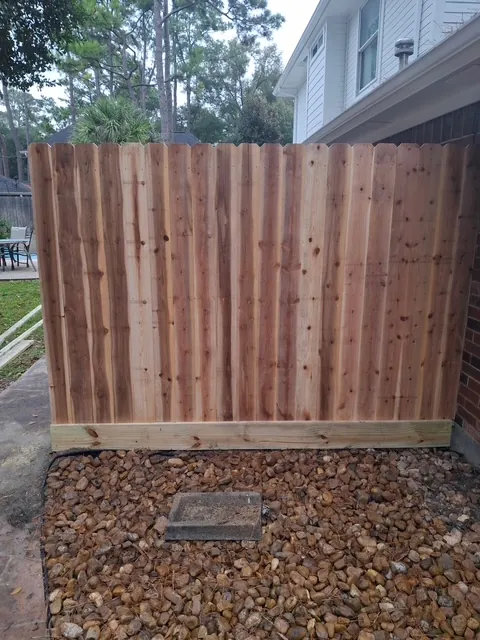
What board-on-board means
In a standard picket fence, boards sit side by side on the rails. In a board-on-board fence, a second layer of boards covers the seams between the first. Wood moves as it takes on and loses moisture, and in a side-by-side fence that movement opens gaps. In board-on-board, the overlap keeps the fence solid as the boards shrink. One recent customer chose it for added privacy when replacing a backyard fence.
Why people pick it
- True privacy. There is no line of sight through a gap, even as boards dry.
- Looks finished from both sides. Boards face both ways, which many neighbors and some HOAs like.
- Stands up to wind a little better. Air passes more slowly through an overlapped fence, but a solid fence also catches more wind, so post depth and spacing still matter.
- Good for pets that watch the street. Dogs that bark at what they see do better behind a solid fence. See pet fencing.
What it costs more
You need more boards for the same length of fence, and the build takes longer. Because the layout varies, we quote board-on-board by site rather than from a single number. For a starting point, standard wood fences run from about $24 to $35 per linear foot in pine and $30 to $44 in cedar as of September 2026. See the cost guide.
Details that matter
- Rails and fasteners. More boards mean more weight on the rails, so rails and fasteners need to be sized for it.
- Bottom rot board. A treated board along the ground keeps the pickets off wet soil. See pine and wood privacy fences.
- Cap and trim. A top cap sheds water and adds a finished line. Check your HOA's rules on caps.
- Stain. Stain evens out the look between layers. See fence staining.
HOA and city rules
Some Sugar Land HOAs describe the fence style they allow, including whether both sides must look finished. Riverstone, for example, lists a Good Neighbor wood fence and a Good Side Out wood fence as separate types in its design standards. See Riverstone fences and the HOA guide. A permit may be required to install a new fence or to change a fence's dimensions. Sugar Land calls it a “Building – Fence” permit, and the city takes applications online through its Citizen Self Service portal. Replacing a fence like for like, without changing its dimensions, may not need one. 76 Fence can help with permitting.
Call or text (281) 769-2116, or book a free estimate.
Questions people ask
What is a board-on-board fence?
A fence where a second layer of boards covers the seams between the first, so there are no see-through gaps as the wood dries.
Is board-on-board more expensive?
Yes, because it uses more boards and takes longer to build. We quote it by site.
Does board-on-board look the same on both sides?
Often, since boards face both ways, but check your HOA's finished-side rule.
Will my HOA allow board-on-board?
It depends on your guidelines. Check with us and we will get a definitive answer from your HOA.