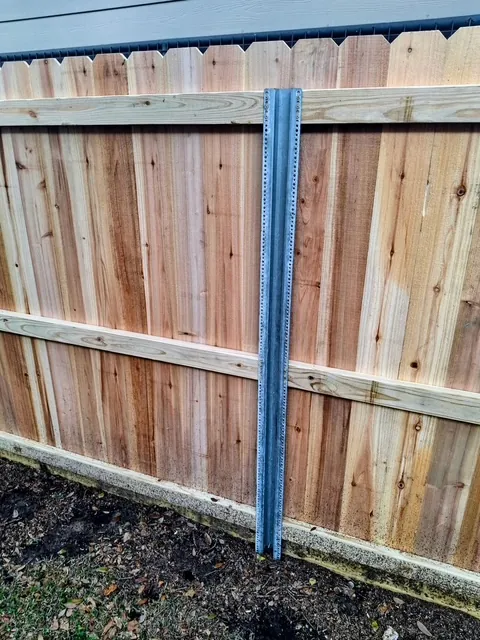
What pine gives you
Pressure-treated pine is the standard budget choice for a six-foot privacy fence. The lumber is treated with preservative so it resists rot and insects better than untreated softwood. It costs less than cedar, so a long run of fence is more affordable. For a rental, a back lot line or a first fence while you save for something nicer, it is a sensible material.
What pine asks of you
- It moves as it dries. Treated pine often holds a lot of moisture when it is new. As it dries it can shrink, twist or check, and gaps may open between pickets. That is normal for the material. A board-on-board layout hides gaps; see board-on-board fences.
- It needs finishing. Most pine fences look better and last longer with a stain or sealer. Follow the product label on how long the wood should dry first. See fence staining.
- The bottom edge decides its life. Wet soil, mulch piled against the boards and sprinkler spray shorten any wood fence. Keep the base clear and consider a treated rot board along the ground.
Pine or cedar?
Cedar costs more, at about $30 to $44 per linear foot, and tends to stay straighter and weather to a more even tone. Pine costs less. We wrote a full side-by-side on cedar vs pine. If the fence will be seen from the house every day and the budget allows it, cedar is worth a look. If it is a back boundary, pine is often enough.
How we build a standard wood fence
For a standard 6 ft wood fence, posts are set 2 feet deep and in concrete. Most fence projects take one to two days once scheduled. Your 18-month limited workmanship warranty starts the day the project is completed. It covers workmanship, and material warranties come from the manufacturer.
Sugar Land clay and your posts
Fort Bend County soil is clay in many places. Clay swells when wet and shrinks when dry, which pushes on posts through the seasons. A properly set post in concrete, with water draining away from the base rather than pooling around it, is the best defense. Low spots and drainage swales need extra thought. See fences, drainage and easements.
Rules to check first
Many Sugar Land HOAs specify the wood, stain and height of a fence. A permit may be required to install a new fence or to change a fence's dimensions. Sugar Land calls it a “Building – Fence” permit, and the city takes applications online through its Citizen Self Service portal. Replacing a fence like for like, without changing its dimensions, may not need one. 76 Fence can help with permitting. See the HOA guide. If your guidelines are unclear, check with us and we will get a definitive answer from your HOA.
Price
| Item | Typical installed price |
|---|---|
| Wood, pressure-treated pine | $24 to $35 per linear foot |
| Wood, cedar | $30 to $44 per linear foot |
| Horizontal wood | $30 to $44 per linear foot |
| Vinyl | $30 to $60 per linear foot |
| Aluminum (ornamental) | $35 to $60 per linear foot |
| Steel (ornamental) | $35 to $60 per linear foot |
| Composite | $50 to $90 per linear foot |
| Chain link | $15 to $45 per linear foot |
| Split rail | $24 to $33 per linear foot |
| Walk gate | $350 to $600 |
| Double drive gate | $500 to $5,000 |
| Gate automation | Starting at $2,000 installed |
| Removal of old fence | $3 per linear foot |
Installed prices for typical jobs as of September 2026. Prices vary by site: access, slope, soil, gate count and material grade all move the number. Minimum job: $1,900. Travel is included in the estimate.
Call or text (281) 769-2116, or book a free estimate.
Questions people ask
How much does a pine fence cost in Sugar Land?
About $24 to $35 per linear foot installed, as of September 2026. Minimum job is $1,900.
Does pressure-treated pine need staining?
Most pine fences last longer and look better with a stain or sealer. Follow the label on how long the wood should dry first.
Why do pine boards twist?
Treated pine often holds moisture when new and can shrink, twist or check as it dries.
Is pine or cedar better?
Cedar costs more and tends to stay straighter. Pine costs less. See our cedar vs pine page.