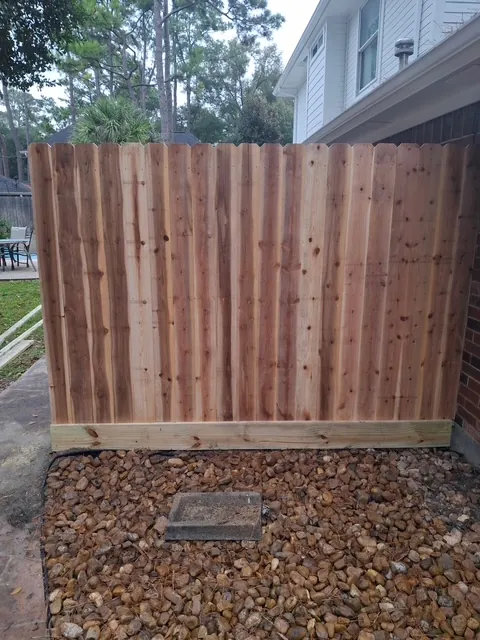
What a standard wood privacy fence is
The standard version is a six-foot fence of vertical pickets nailed or screwed to horizontal rails, which are fixed to posts. Pickets can overlap in a board-on-board layout so there is no gap as the wood shrinks, or sit side by side in a basic dog-ear pattern. The posts do the structural work. For this style, ours are set 2 feet deep and in concrete.
That depth is not an upsell. A six-foot solid fence is a sail in a Gulf Coast windstorm, and the post is the only thing between the wind and your neighbor's yard. Skimping on post depth, or setting posts in loose dirt, is the cheapest way to build a fence and the most expensive way to own one.
Pine or cedar
Pressure-treated pine is the budget choice at about $24 to $35 per linear foot. Cedar is about $30 to $44 per linear foot. Cedar runs roughly $6 to $9 more per foot, about 25 percent. Cedar is naturally more resistant to rot and insects and tends to hold a flatter face, while treated pine is chemically protected and usually cheaper. Our cedar versus pine page goes through the trade-offs with real numbers for a typical backyard.
The details that decide how long it lasts
- The bottom board. The board closest to the soil is the first to rot. A pressure-treated board at the base, with the pickets sitting above it, gives you a part that can be replaced without rebuilding the fence. The photo above shows this.
- Soil contact. Mulch, rock and irrigation that keep soil piled against the wood shorten its life. Leave a small gap, and keep sprinkler heads from spraying the fence.
- Gates. Gates carry more stress than any other part of a fence. We cover how to keep them from sagging on the gates page.
- Fasteners. Rust-resistant screws or nails matter in humid air.
- Finish. Stain protects the wood and, in some HOAs, sets the allowed color. We stain fences in a variety of colors, including an HOA-required color. See staining.
Clay soil and wood posts in Fort Bend County
Much of the Houston area sits on clay that swells when wet and shrinks when dry. That movement pushes on posts. Concrete collars around the posts, plus holes deep enough to get below the surface layer that moves most, are why a properly set fence stays straight through a wet spring and a dry August. If you have seen leaning fences in your neighborhood, shallow or un-concreted posts are the usual reason.
Before you build in Sugar Land
If your home is in an HOA, the architectural review authority will usually want to approve the height, picket style, stain color and gate placement before work starts. Our HOA guide explains the process and what to submit. If your HOA guidelines are unclear, check with us and we will get a definitive answer from your HOA. A permit may be required to install a new fence or to change a fence's dimensions. Sugar Land calls it a “Building – Fence” permit, and the city takes applications online through its Citizen Self Service portal. Replacing a fence like for like, without changing its dimensions, may not need one. 76 Fence can help with permitting.
Check for easements along the back and sides of the lot too. Some Sugar Land lots back onto drainage channels or utility corridors, and a fence in the wrong place can be ordered moved. See drainage, easements and levees.
Price, timing and the next step
A 150-foot backyard in pine at the typical range is roughly $3,600 to $5,250 before gates. In cedar it is roughly $4,500 to $6,600. A walk gate adds about $350 to $600. These are examples of the math, not quotes, and prices vary by site. Removal of an old fence is $3 per linear foot. The minimum job is $1,900. Call or text (281) 769-2116 or book a free estimate.
Questions people ask
How tall is a standard wood privacy fence?
Six feet is standard. Taller or shorter heights depend on your HOA and the city; ask us before you plan an unusual height.
How deep are the posts?
For a standard 6 ft wood fence, posts are set 2 feet deep and in concrete.
How long does it take to build?
Most fence projects take one to two days once scheduled.
Is pine or cedar better?
Cedar costs about 25 percent more and resists rot and insects naturally. Pine costs less and is chemically treated. See the cedar versus pine page.
Can you match the stain color my HOA requires?
Yes. We stain fences in a variety of colors, including an HOA-required color.