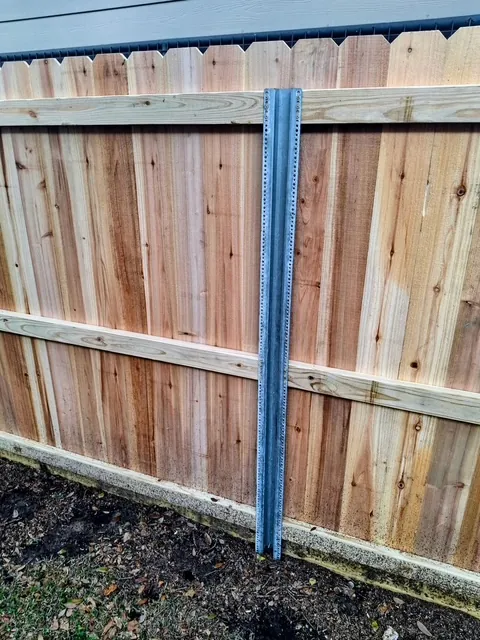
Why fences lean
- Rotted posts. Wood in contact with wet ground decays at the base, which is where a post carries the load.
- Shallow or poor footings. A post set too shallow, or without good concrete support, can shift. A standard 6 ft wood fence of ours has posts set 2 feet deep and in concrete.
- Clay soil. Fort Bend clay swells when wet and shrinks when dry, which works posts loose over time.
- Wind and storms. A solid fence catches wind like a sail. See storm damage.
- Water at the base. Poor drainage, sprinkler spray and mulch piled against boards all speed rot.
- Failed rails or hardware. If the posts are straight but panels droop, rails and fasteners may be the problem.
- Trees and roots. Roots can push posts and lift sections of fence.
A simple check
- Stand at the end of the fence and sight down the line. Mark where it leans.
- Push on the post at the top. A post that moves at the base is loose or rotted.
- Poke the base with a screwdriver. Soft, crumbling wood means rot.
- Look at rails and fasteners. Rust, splits and pulled nails mean hardware failure.
- Photograph it and send it to us.
What can be repaired
- A single failed post can often be replaced without replacing the whole fence.
- Broken rails and boards can be swapped out.
- A sagging gate can be rehung and braced; see gates.
We do not quote repair prices on this site, because repairs vary too much. Send photos and we will give you an honest answer. If most posts have failed, replacement makes more sense than patching.
Shared fences and HOAs
If the fence is shared with a neighbor, talk to them first. Some HOAs ask owners to maintain fences, and some require approval even for repairs that change the look. See the HOA guide. A permit may be required to install a new fence or to change a fence's dimensions. Sugar Land calls it a “Building – Fence” permit, and the city takes applications online through its Citizen Self Service portal. Replacing a fence like for like, without changing its dimensions, may not need one. 76 Fence can help with permitting.
Prevent the next lean
- Keep soil and mulch off the base of the fence.
- Aim sprinklers away from boards.
- Keep the fence stained or sealed. See fence staining.
- Fix a loose post early. It is cheaper than fixing a fallen run.
Call or text (281) 769-2116, or book a free estimate.
Questions people ask
Why is my fence leaning?
Usually rotted or loose posts, but also failed rails, wind or clay soil movement.
Can a leaning fence be fixed without replacing it?
Sometimes. A single failed post or a few rails can be replaced. If most posts have failed, replacement is usually better.
How do I tell if a fence post is rotted?
Push the post at the top. If it moves at the base, and a screwdriver sinks into soft wood, it is likely rotted.
Does repairing a fence need approval?
Some HOAs require approval even for repairs. A permit may be required to change a fence's dimensions. 76 Fence can help with permitting.