Why height alone is not the answer
A dog's jump depends on size, athleticism and motivation. A fit retriever or a border collie can clear a four-foot fence from a standstill. A dog that wants to reach something on the other side, a squirrel, a neighbor's dog, or a gate that is a few feet away, will try harder. Height is a starting point. What the fence is made of and what the dog can grip, step on or see through matters as much.
A practical height guide
| Dog | Common starting point | Notes |
|---|---|---|
| Small or low-energy | 3 to 4 feet | Gaps matter more than height. See the small dog page. |
| Medium, average jumper | 4 to 5 feet | Solid is safer than open. |
| Large, athletic or a known jumper | 6 feet, solid | Check that your HOA allows it. |
| Climber | 6 feet, smooth face | Avoid horizontal rails on the inside. |
These are general starting points, not guarantees. Your dog may be better or worse at escaping than the average.
Solid or open for a jumper
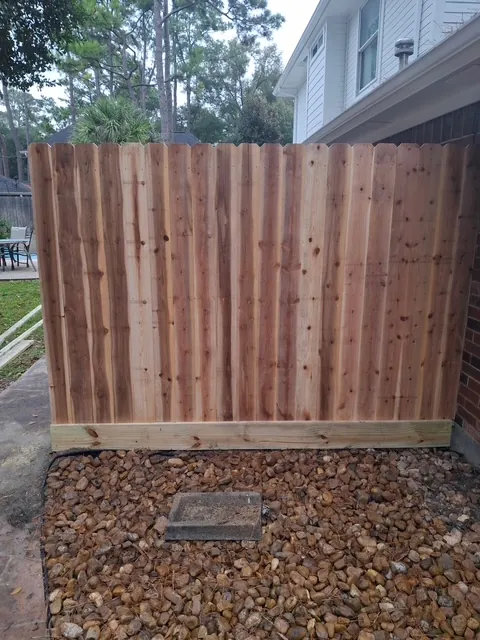
Dogs jump more at fences they can see through, because they see a target. A solid fence removes the target. For a jumper, a six-foot solid fence in wood or vinyl is the safest common option. An open aluminum fence at the same height works for dogs that are calm, but it is a poor choice for dogs that react to passing people and animals.
Climbing
Horizontal boards, rails on the inside face and chain link all give a dog a place to put its feet. A fence with the rails on the outside and a flat inside face is harder to climb. Planters, dog houses and stacked firewood near the fence line turn a fence into a ladder. Keep a gap.
Materials compared for dogs
- Wood. Solid, quiet and sturdy. Chewers can gnaw a board, so check boards near gates. See cedar versus pine.
- Vinyl. Smooth and hard to climb. Solid panels block sight lines.
- Aluminum and steel. Strong and durable. Check the spacing between pickets, and the rails.
- Chain link. Inexpensive at $15 to $45 per linear foot as of September 2026, but climbable, and some dogs chew the coating.
Gates and latches
Dogs learn to lift latches, push gates and squeeze through hinge gaps. A latch with a locking mechanism, hardware at a height the dog cannot reach and tight clearance at the hinge side are worth asking about. See gates.
Rules in Sugar Land
Check your HOA's height limits before you plan a taller fence. If your HOA guidelines are unclear, check with us and we will get a definitive answer from your HOA. A permit may be required to install a new fence or to change a fence's dimensions. Sugar Land calls it a “Building – Fence” permit, and the city takes applications online through its Citizen Self Service portal. Replacing a fence like for like, without changing its dimensions, may not need one. 76 Fence can help with permitting. See the HOA guide.
Call or text (281) 769-2116 or book a free estimate, and tell us about your dog.
Questions people ask
Is a four-foot fence enough for a dog?
For some dogs. Many athletic dogs clear four feet, so ask us about your dog.
Does my HOA allow a six-foot fence?
Many fences are six feet, but heights vary by HOA. Check with us and we will get a definitive answer from your HOA.