The rule: no gap bigger than the dog
A small dog does not need to jump. It needs to find an opening. Measure the widest part of the dog, usually the chest, and treat that as the maximum gap anywhere in the fence. Puppies change quickly, so the opening that is too small for a three-month-old may not be for an adult, and the opposite is true too: a gap an adult cannot use may still be a hole for a puppy.
Where small dogs get through
Between pickets
Picket fences, wood or vinyl, set the gap between pickets. Standard spacing can be wide enough for a small dog. A tighter spacing, or a board-on-board privacy layout, closes it.
Between ornamental pickets
Aluminum and steel panels come with a set spacing. Check it against the dog before you choose. If the spacing is wide, a narrower-spaced panel or a mesh liner can close it. See aluminum and steel.
Under the fence
Small dogs squeeze under low spots and gaps at the bottom rail. A continuous bottom board and level ground reduce it. See dig-proof fences.
At the gate
The gap between the gate and the post, and under the gate, is often the weakest point. Ask about hinge-side clearance and a gate that sits low to the ground. See gates.
At the corners and the house
Where a fence meets the house, the garage or a neighbor's fence, small gaps appear. Check every joint.
What to choose
- Board-on-board or solid wood. No gaps between boards. See wood privacy fences.
- Vinyl privacy panels. Solid, with the bottom rail near the ground.
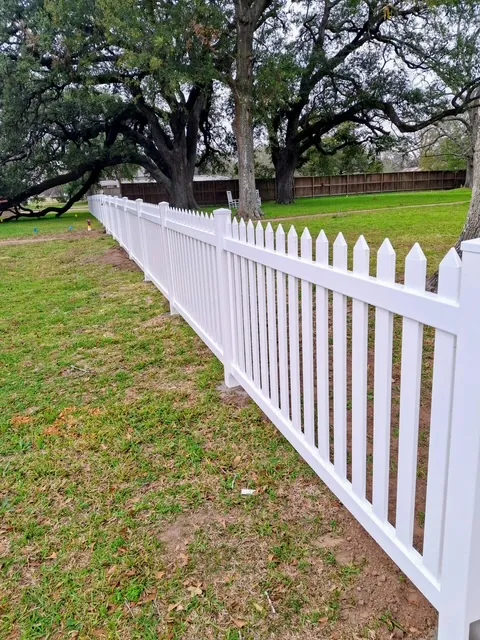
- A picket fence with tighter spacing. Looks like a classic yard fence and works if the spacing suits the dog. The white fence on our projects page is a good example of the style.
- Ornamental with a liner. Keeps the view, but check the spacing.
Plan for growth
If you are getting a puppy, plan for the adult. Choose a fence that works for the full-grown dog's size and jumping, and put in the right gate hardware now. Rebuilding a fence later costs more than choosing carefully today.
Small dogs and other animals
Small dogs are also at risk from outside animals. A solid fence with no bottom gap keeps others out as well as your dog in.
HOA and permit notes
Your HOA may specify picket styles and spacing. If your HOA guidelines are unclear, check with us and we will get a definitive answer from your HOA. A permit may be required to install a new fence or to change a fence's dimensions. Sugar Land calls it a “Building – Fence” permit, and the city takes applications online through its Citizen Self Service portal. Replacing a fence like for like, without changing its dimensions, may not need one. 76 Fence can help with permitting.
Tell us the dog's breed and size when you call (281) 769-2116, or book a free estimate.
Questions people ask
How wide a gap can a small dog squeeze through?
Any gap wider than the dog's head and shoulders. Measure your dog's chest and treat that as your limit, and plan for growth in a puppy.
Is a picket fence good for a small dog?
It can be, if the picket spacing is tight enough. Otherwise a solid fence is safer.